When brand founders search for a “cosmetics lab UK”, they are usually looking for one of two things: a formulation and manufacturing partner who will develop and produce their products from scratch, or a testing facility that will assess the safety and stability of formulations they have already developed. This guide focuses on the former – finding a UK cosmetics lab that can take your product idea from brief to finished, shelf-ready product.
The UK has a strong cosmetics manufacturing sector, with a number of specialist labs offering bespoke formulation, contract manufacturing or both. Choosing the right one depends on your product category, the stage you are at in development, your target market, and the scale you are working at. This guide covers what to look for, what questions to ask, and what the process of working with a UK cosmetics lab actually looks like.
What a UK Cosmetics Lab Does
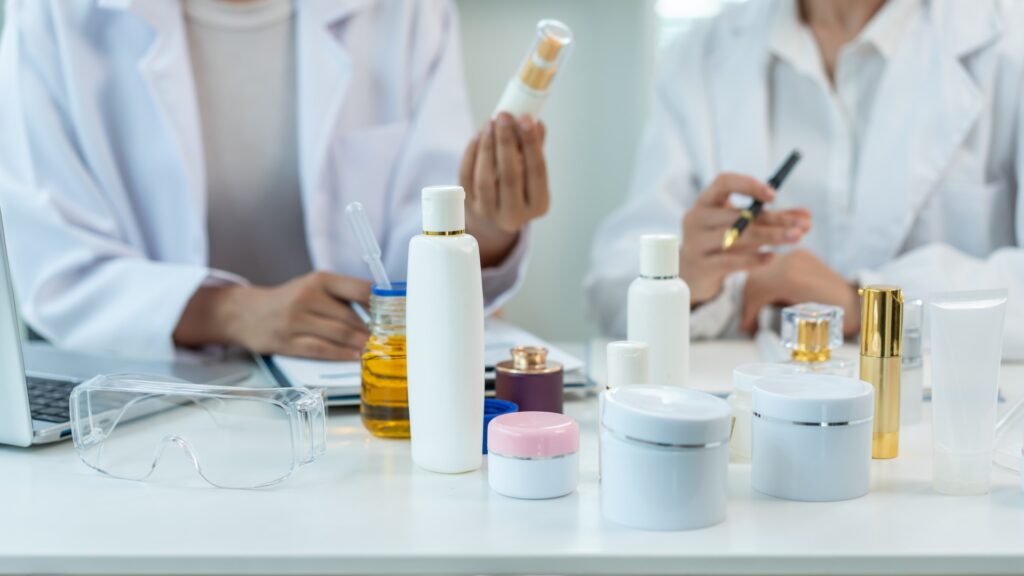
A cosmetics lab – in the sense most brand founders are looking for – is a facility that can develop and manufacture cosmetic products. The two core activities are formulation and production, and many labs offer both under one roof.
Formulation
Formulation is the process of developing the product itself: selecting ingredients, determining the right ratios and processing conditions, and iterating until the texture, performance and stability meet the brief. A good cosmetics lab will have chemists and formulators who specialise in specific product categories – colour cosmetics, skincare, haircare, or hybrid products that sit across categories.
Formulation is not simply mixing ingredients together. It involves understanding how ingredients interact, how a formulation will behave under different conditions (heat, cold, light, packaging contact), and how to achieve consistent results at production scale. It also requires knowledge of UK and international cosmetics regulations, since the choice of ingredients and their concentrations is governed by law.
Production and contract manufacturing
Once a formulation is approved, production involves manufacturing the product at commercial quantities – filling, labelling and packaging it ready for sale. Some cosmetics labs offer small-batch and large-batch production under the same roof; others specialise in one or the other.
Contract manufacturing means the lab produces products to your specification, using your approved formulation. This is the model most independent brands and retailers use. Who owns the formulation depends on the individual project and what is agreed with the lab.
Testing and safety
Before a cosmetic product can be sold in the UK, it must have a Cosmetic Product Safety Report (CPSR) completed by a qualified safety assessor – someone with a degree in pharmacy, toxicology, medicine or a similar discipline. Some cosmetics labs facilitate this as part of their service; others expect the brand to arrange it independently. Either way, the lab should be able to explain what testing and support is included for your project, as this will vary from brief to brief.
Why Work with a UK Cosmetics Lab
For brands selling into the UK market, working with a UK-based cosmetics lab has a number of practical advantages over sourcing from overseas:
| Advantage | What it means in practice |
|---|---|
| UK regulatory compliance | All products are formulated and manufactured to UK cosmetics regulations as standard. No need to navigate compliance separately or rely on a supplier’s interpretation of UK law. |
| Speed of development | Working in the same timezone with no shipping delays on samples means development rounds are faster. Sample rounds can often be turned around more quickly than with an overseas supplier. |
| Communication | Direct access to the formulator working on your product makes a significant difference during development. Being able to pick up the phone to discuss a brief or give feedback on a sample is something many brand founders underestimate until they have experienced the alternative. |
| No import complications | Finished goods manufactured in the UK ship domestically. No customs clearance, no import duties, no risk of delays at the border. |
| Traceability | UK manufacturers operate under strict GMP standards with full ingredient and production traceability. This matters for audits, retailer requirements and consumer transparency claims. |
| Flexibility on quantity | UK cosmetics labs often offer lower minimum order quantities than large overseas factories, which is valuable for brands at the launch stage or those testing new products before scaling. |
What to Look for When Choosing a UK Cosmetics Lab
Not all cosmetics labs are the same. Here are the key things to assess before committing to a manufacturing partner:
Product category expertise
A lab that specialises in skincare may not have the colour cosmetics expertise to develop a lipstick or eyeshadow palette. Check that the lab you are considering has direct experience in your product category – and ask to see examples or speak to existing clients if you can.
GMP certification
Good Manufacturing Practice (GMP) certification to ISO 22716 is the baseline standard for cosmetics manufacturing. It covers premises, equipment, personnel, documentation and production processes. Any reputable UK cosmetics lab will hold this certification. If a potential supplier cannot provide evidence of GMP certification, that is a significant red flag.
Regulatory knowledge
The lab should have clear processes for UK cosmetics compliance – ingredient restrictions, labelling requirements, guidance on the CPSR and notification via the Submit a Cosmetic Products Notification (SCPN) service. If they are vague about this, it suggests either limited experience or a lack of interest in UK-market specifics.
Minimum order quantities
MOQs vary considerably between labs. Some require minimum runs of several thousand units; others will work with much smaller quantities. If you are launching a new product or testing a formulation before scaling, lower MOQs give you the flexibility to validate demand before committing significant capital.
Transparency about lead times
Development and production timelines depend on how busy the lab is, how complex the formulation is, and whether any testing is required before production. A reliable lab will give you realistic timelines upfront and keep you informed if anything changes. Be wary of suppliers who are vague about timelines or consistently optimistic.
Packaging capability
Can the lab source and fill your chosen packaging, or do you need to supply it? Integrated packaging sourcing simplifies the process considerably, particularly for brands that do not have established supplier relationships. Ask whether the lab has preferred packaging suppliers they work with and whether they can advise on packaging that is appropriate for the formulation.
The Development Process: What to Expect
Working with a UK cosmetics lab for the first time can feel opaque if you do not know what to expect. Here is a typical development process:
- Brief – you share your product concept, target consumer, key ingredients or claims you want to make, preferred texture and finish, and any reference products you like. The more specific the brief, the more efficiently development proceeds.
- Initial formulation – the lab develops one or more prototype formulations based on the brief and sends you samples for assessment.
- Feedback and iteration – you review the samples and provide detailed feedback. This round may repeat several times depending on how close the first prototype is to the target.
- Testing and safety – once a formulation is approved, the testing needed will depend on the product and project, and a CPSR will need to be prepared by a qualified safety assessor.
- Production – the approved formulation is manufactured at the agreed quantity, filled, labelled and packaged.
- SCPN notification – before the product is placed on the UK market, it must be notified via the Submit a Cosmetic Products Notification (SCPN) service. The level of support with this step will depend on the individual project.
Timelines vary from project to project, depending on the complexity of the formulation, the number of development rounds and any testing requirements. A good lab will give you a realistic timeline once they understand your brief.
Creative Cosmetics: A UK Cosmetics Lab in Ipswich
Creative Cosmetics is a GMP-certified UK cosmetics lab and manufacturer based in Ipswich, Suffolk. We specialise in colour cosmetics – lipsticks, lip glosses, lip oils, eyeshadow, foundation and hybrid colour-skincare products – and work with brand founders, independent brands and retailers at a range of scales.
Our in-house formulation team, led by our Head of R&D Katarina Kozlikova, develops bespoke formulations tailored to each brand’s brief. We offer low minimum order quantities, making us a practical partner for brands at the launch stage as well as those scaling an established range.
We are GMP certified to ISO 22716 and operate with full ingredient and production traceability. The level of development and regulatory support we provide will depend on the individual project.
Getting Started
If you are looking for a UK cosmetics lab to develop and manufacture your products, the best first step is a conversation with our team. We can discuss your brief, advise on what is achievable and give you a realistic picture of timelines and costs before you commit to anything.
Visit creativecosmetics.com or call us on 01473 685599.